Tagged: Ozarks

Poison Ivy…or not?

Every blog, website, magazine, and guidebook dealing with the outdoors has a section warning you of the terrible toxic weeds poison ivy, poison oak, and poison sumac. There are always pictures. And yet when I go out in the woods with people I find that many (if not most) people really don’t know what to look out for and end up being afraid of perfectly harmless plants.

More >

Ozarks Spring Wildflowers: Wild Blue Phlox

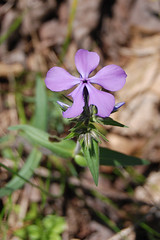
Wild Blue Phlox, Phlox divaricataAlso known as Wild Sweet William, Wild Blue Phlox is a favorite spring wildflower gives bright splashes of color to the woodlands. Growing best in the dappled shade of the woodland borders and preferring well drained ground, you often see Blue Phlox decorating the edges of trails.

More >

Ozarks Spring Wildflowers: Wild Ginger

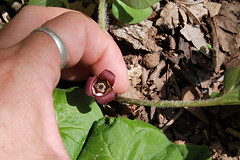
Wild Ginger, Asarum canadense flowerOf course the name of this plant always makes me smile. My name is Ginger, of course, so Wild Ginger just sounds so…wild and fun and rather appealing. This plant is not really a ginger like the root we use in cooking. That is Zingiber officinale and only grows in the tropics. Our native Wild Ginger is actually called Asarum canadense. But it gets its name from the spicy roots that have been used medicinally.

More >

Ozarks Spring Wildflowers: Pussy Toes

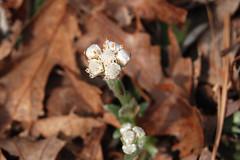
Pussy Toes, Antennaria plantaginifoliaDown underneath the leaf litter of the forest floor the basal leaves of Pussy Toes begin to peek through. You start to notice these rosettes of silvery green leaves. Soon you see there are buds poking through and pushing up on a stalk.  After a week or so you begin to see where Pussy Toes gets its name. The little flowers on the ends of the stalks are a bit fuzzy and resemble the little toes of kittens.

More >

Ozarks Spring Wildflowers: The Violets

Wood Violet (Viola sp.)The spring-blooming violets capture the romantic imagination of poets and songwriters. Growing in well-drained yet fairly moist areas in the hills of the Ozarks, there are dozens of different species and variations. You will see violets that are blue, purple, lavender, white, and yellow. Some are bicolored. Some are striped. Many have little fuzzy beards in the throat of the flower.

More >

Ozarks Flowering Tree: Sassafras

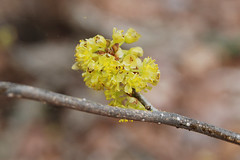
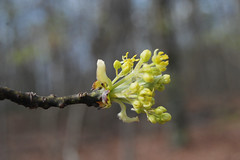
Sassafras, Sassafras albidumI moved to the Ozarks when I was nine years old and one of the first plants I learned about was the Sassafras tree. My mother dug up a bit of the root and let me smell it. I carried it around for a while and probably kept it in my treasures for years. It amazed me that such a simple looking tree could make such a great smell.

More >

Ozarks Flowering Tree: Downy Serviceberry

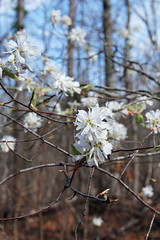
Serviceberry, Amelanchier arboreaIn the very early spring, before the leaves begin to show on any trees of the forest, you will see trees in the forest understory covered with white flowers. Some might think these are a fruit tree like a plum or perhaps even a dogwood. But no. If you get a chance, take a look at the flowers up close.

More >

Places to go: Piney Creek Wilderness

Right off the bat, the most unusual thing about this Wilderness area is that its boundaries circumscribe the entire drainage of Piney Creek. So you always start on a ridge and go down into the valley of the same creek system. There isn’t a lot of up and down all day hiking. Once you’re down in the valley it’s flat. Piney Creek opens into Table Rock Lake on the east, allowing access to and from the lake…

More >

Ozarks Spring Wildflowers: Trout Lily

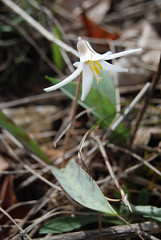
Trout Lily, Erythronium albidumIn the spring among the Spring Beauties and the Rue Anemones I started to notice single boat-shaped leaves that were a dusty green with brown mottling. None were blooming so I had to wait to see what they were. Sure enough, the next week I started seeing this striking flower above the foliage. Trout Lily is a rather unattractive name for such a pretty flower, I think. But it must refer to the mottled leaves.

More >

Ozarks Spring Wildflowers: Spring Beauty

Spring Beauty, Claytonia virginicaIn the very early spring you often see small white flowers with pink veins called Spring Beauties. They don’t last long peeking through last year’s leaves on the forest floor. Some flowers have more pink than others, with many being nearly pure white. The medium green leaves are thin blades like grass but are more fleshy and thick.

More >

Ozarks Spring Wildflowers: Bird’s Foot Violet

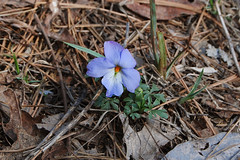
Birds's Foot Violet, Viola pedataThese are really a nice flower. They’re tough as nails and grow on the scruffy edges of roads and on glades where it’s dry. The foliage is subtle and lies below the large blue flat-faced flowers held on single stems coming from the center of the plant. The flowers are larger than you would expect from the foliage. The leaves, by the way, are where this plant gets its common name, Bird’s Foot Violet. Because the leaves are forked like a bird’s foot.

More >

Ozarks Spring Wildflowers: Hepatica americana

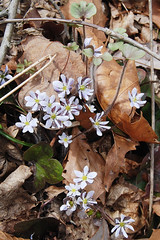
Roundlobe Hepatica, Hepatica americanaHiking quickly up a hill near a river, trying to avoid sliding into the mud, I looked down and saw this slightly bluish wildlower and assumed it was a Rue Anemone. I reached down to snap a picture and then moved on. When I got back home and looked that the pictures I was stunned to see this plant had interesting mottled tri-lobed leaves that looked like they’d already lived through a winter. What I had seen was actually Roundlobe Hepatica, or Hepatica americana.

More >